


I have always been good at the Irish goodbye.
Once the bill has been paid and an evening has gone on long enough for the best stories to begin their second trip around the table, I’ll exuse myself for the bathroom and quietly leave. By the time somebody asks where I went, I am usually in the car listening to music at a volume my wife wouldn’t appreciate.
Later I send a message saying I had a great time. This is partly gratitude and partly proof that I was not taken from the parking lot.
I have done a version of this on Sunday mornings too. As a pastor, I can tell when someone is developing a question during the sermon. The head tilts, a pen appears, and before long the bulletin is being underlined with more force than the paper was designed to withstand.
On those mornings, I have been known to move from the pulpit toward a side hallway with surprising speed for a man who hasn’t played organized sports this century. If asked, I am checking on something in the office, although nobody knows what that might be, including me. Its one of the practical benefits of having more than one pastor.
The church version is harder because everybody knows which car belongs to you.
Most of the time, disappearing is a minor social offense. My friends will see me again. The person with the marked-up bulletin knows where I work.
On Thanksgiving in 2000, my grandpa called and asked me to go hunting with him. I was fifteen years old, and there was a cute girl from a rival high school I wanted to chat with on ICQ instead. I thought I might see her at the mall on Black Friday.
This was, of course, back when teenagers went to the mall hoping to run into somebody and then acted surprised when they did. I did not know whether the girl would be there. I don’t remember making plans with her. My entire plan rested on the word might, but boys have built larger structures on weaker foundations.
“No, I’m not coming,” I told my grandpa.
“I don’t have any clean clothes,” was the excuse I gave to him, knowing full well it was a lie.
He died that evening.
I didn’t go to the mall the next morning. Instead, I went to my grandparents farm to be with my grandma who had lost the only man she’s ever loved.
I can’t tell you if I ever saw that girl at the mall. I can’t remember if we had anymore conversations on ICQ. You would think I might remember that, considering the importance I had assigned to the possibility. I do not. I remember what I said to my grandpa.
I thought I was turning down one hunting trip. There would be another Thanksgiving and another hunting season. The idea that there might not be another afternoon with my grandpa never entered into it.
For years I returned to that conversation and answered differently. I got in the truck, spent the day with him, and came home with one more story. Then I returned to the Thanksgiving that actually happened.
I do not know what my grandpa thought when I said no. Maybe he was disappointed. Maybe he shrugged. I have occasionally been tempted to give him a warm speech about how he understood and never held it against me, but that would be me writing his lines after he was no longer here to correct them.
What I know is that I stayed home. By the time I understood that the conversation needed a goodbye, there was nobody left to say it to.
Unfortunately, this did not turn me into a man who answers every call and accepts every invitation. I still watch the phone ring when I am tired. I still compose replies in my head and forget to send them. I remain capable of learning an important lesson on Sunday and losing track of it by Tuesday.
Years later, I was dog-sitting for my brother when I learned that Macho Man Randy Savage had died.
I had recently gone through a divorce, been fired from my job, and moved back to my childhood bedroom. Keeping one dog alive felt about the right level of responsibility for a man that down on his luck.
The job came with a bowl, a leash, and a clear way of knowing when I had fallen behind. The rest of my life was not offering that kind of customer service.
I was scrolling through Twitter when the TMZ message appeared.
Randy Savage was dead. I refreshed the page and read it again. Nothing in my brother’s living room changed. The dog did not lower the flag.
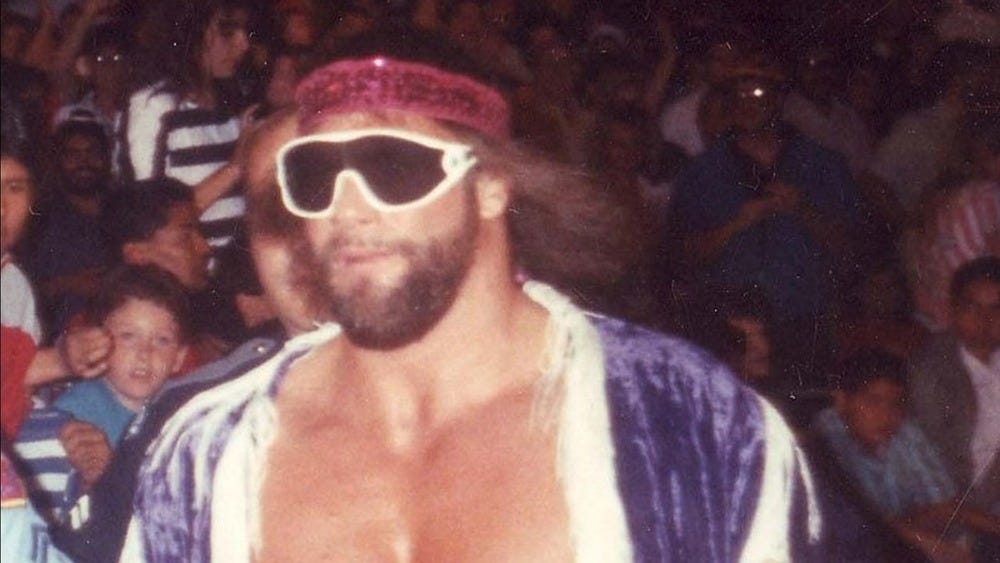
Macho Man had never seemed built for ordinary human limits. He wore enough fringe to furnish the entire country music industry in 1993, then climbed to the top rope and came down with an elbow that made gravity look like part of the show.
The way he died felt unbelievable.
He was never my favorite wrestler, but he had always been there, or at least it felt that way. He felt like he would always be there, too.
Wrestling encourages this confusion because the old matches remain available. You can call up 1988 after supper and find Savage every bit as young and furious as he was the first time. He drops the elbow again. The announcer shouts again. Meanwhile, I have reached the age where if I sleep at the wrong angle, my neck punishes me.
I did not grieve Savage the way I grieved my grandfather. One man knew my name. The other might have called me “brother,” but that was simply the system wrestling had developed for addressing strangers, which strangely enough is how I also address men in my church who I can’t recall their name.
Still, Savage had been in my house for years. He had shouted through the television while families ate, talked, left the room, and came back to find him still arguing with Mean Gene.
Some of the people I know through wrestling exist for me almost entirely on a screen. I know what they think about star ratings and which promotion they will defend well past the point of sound judgment. I may know what shift they work or that one of their children has been sick. I may not know their last name. Every so often, one of them goes quiet.
At first you assume work got busy. A few days pass, then a few weeks. You check the profile and discover that the last public statement was an argument about whether flips belong in wrestling, which is not the farewell most of us would select if somebody gave us time to prepare one.
They may have deleted the app or started a new account. Perhaps they grew tired of all of us and took up gardening, which is probably better for the blood pressure than discussing what Metlzer thinks. You hope they are somewhere doing fine.
There is nobody to call. The friendship grew through replies, group chats, and late-night messages. No one stopped in the middle of an argument about headlocks to exchange a spouse’s phone number in case one of the accounts suddenly went dark. That would have seemed strange at the time. It only seems practical afterward.
So you send a message: “Hey, just checking on you. Hope you’re okay.”
Sometimes an answer arrives. Work became busy or life became complicated, and they needed to step away for a while. I am always releived to learn that somebody has merely decided the internet is terrible. Other times the message stays where you left it.
There’s phone numbers in my contacts that once belonged to people I will never speak to again. Some of those people died. Others simply passed out of my life, but I’m never deleting them. It’s this sort of completionist thinking that led my to watch all of Candela’s matches in 2026, for better or worse. Besides, deleting a phone number of a friend who has passed on feels needlessly official, like driving downtown to file paperwork nobody requested.
The phone company has fewer reservations. Eventually a number is handed to somebody else. Somewhere, a person I will never meet may now carry a number my phone still associates with a familiar name and memories I’ll hopefully never forget.
Like Adam, the rock climbing bartender I only knew for a few years before he passed away, but showed up in my life like an illegal firework show. You knew it was dangerous. You knew it would burn out eventually, but while it was around, it lit up the night.
Or my friend Geof, who I never met in person, but had more influence on me than I’ll likely ever admit. I cheer for the Celtics in his memory every year, and always drink scotch in his honor.
My phone still offers me the little green call button. Every so often I scroll past one of those names and pause. I know a different voice would answer now, so I leave the contact where it is.
As you know, I’m a pastor, and I’m a Christian, and I believe things about death and what comes after it. We can talk about that sometime, if you wish, but being a pastor means people sometimes look at me after a death as if seminary prepared me with the exact words to give someone about death to help them understand it. That didn’t happen, although I haven’t gone for my doctorate yet. Still, I have hope for what comes after death. I also miss people and keep useless phone numbers.
I still leave parties quietly. Midwestern goodbyes are already long enough. You say goodbye in the living room, repeat it at the front door, continue talking on the porch, and then roll down the car window because somebody remembered one more thing. At some point a person has to leave or apply for residency.
Lately I have tried to send the message before anyone notices I am gone. On Sundays, I occasionally remain in the lobby long enough to receive the question written in the bulletin. I do not want to overstate my progress.
So what on earth does this have to do with wrestling?
Nothing really.
Except wrestling is full of people who seemed too loud, too bright, too alive to ever disappear. Then one day they do, and all that’s left behind are memories and old matches.
Maybe that’s enough.
Send the message. Take the hunting trip. Stay in the lobby for the question.
And when you leave, if you can help it, don’t forget to say goodbye.