


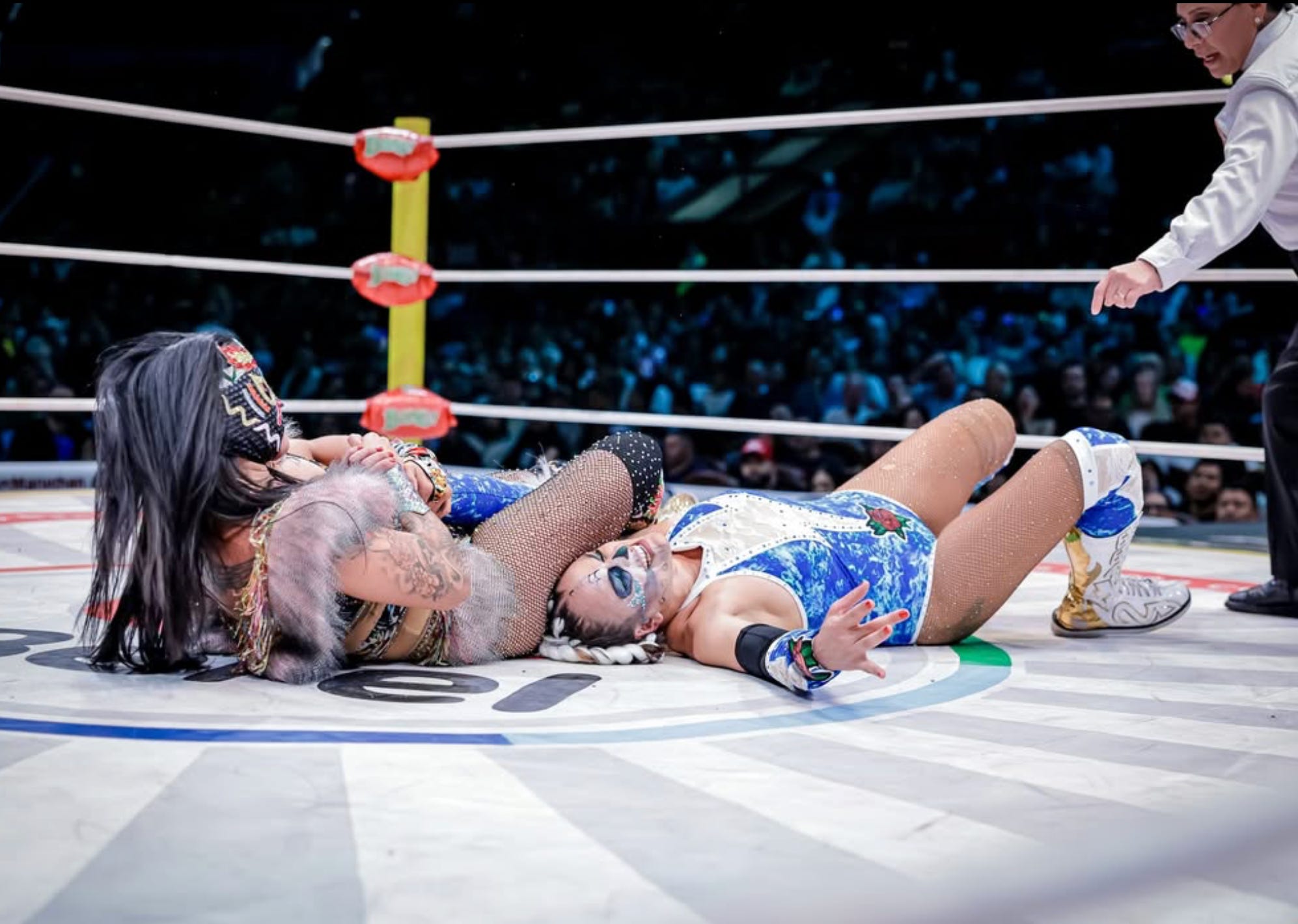
Some mornings I sit down at my computer with the results from Arena México open in one window and a spreadsheet open in another, and I enter the latest information about the luchadoras of CMLL.
Date. Match. Partners. Opponents. Winner. Loser.
I check the spelling of names I have already checked dozens of times, look through results written in Spanish I understand poorly, and try to decide whether a match belongs in one category or another. Every now and then I discover that I missed something from Puebla or Guadalajara, which means going back to repair the record as if someone from the Mexican government might arrive later that afternoon to inspect it.
No one has asked me to do this.
I am reasonably certain CMLL does not care that I do it. CMLL itself may not keep these records with the concern I have developed for them, which would be funny if it were not also a little unsettling. Somewhere in Ohio, a middle-aged pastor is carefully maintaining a history of outcomes decided in advance by a wrestling promotion in Mexico City that does not know he exists.
My wife will occasionally walk past the office, see the spreadsheet on the screen, and keep walking. There are questions in a marriage that are better left unasked.
The records become articles, or pieces of articles. I write about Candela, Skadi, Tabata, Persephone, Olympia, and the other women of CMLL. I write about who is improving, who keeps getting booked with whom, who quietly put together a good month, and who loses more often than the crowd’s affection for her would suggest.
Then I publish the piece and wait.
A few people read it. Not many.
There is no great surge of interest in the win-loss record of Candela. Nobody is refreshing Working The Crowd or The Luchadora Project on a Wednesday afternoon because the outcome of Tabata’s latest trios match has left a hole in his understanding of the universe. The readership wanders in one person at a time, hangs its coat by the door, and sits toward the back.
This has started to make me wonder whether what I am doing is futile.
That is not a pleasant question once you reach the stage of life when time no longer feels unlimited. When you are young, an afternoon is just an afternoon. You can spend it watching wrestling, arguing about wrestling, reading about wrestling, and then watching several men on television argue about the wrestling you have already watched. The day is wide, supper will appear somehow, and tomorrow is too far away to be much concern.
That changes.
Marriage changes it. Ministry changes it. A family growing through adoption certainly changes it. The hours begin to have names attached to them. An hour at the computer belongs entirely to the computer and cannot also belong to your wife, your family, the people you pastor, the book you have been meaning to read, or the toilet downstairs that has been making a sound for three weeks.
So I look at the spreadsheet and ask the sort of question a man asks when he suspects the answer may inconvenience him.
Is this wise?
Not whether it is allowed.
There is no commandment against tracking the records of luchadoras, though the practice may be covered somewhere in the minor prophets. The question is whether putting real time and thought into something almost no one cares about is a faithful use of the life I have been given.
I can remember visiting churches with hymn boards mounted near the front of the sanctuary. Before the service, somebody would slide little white numbers into narrow wooden slots so everyone knew which hymns we would sing. Number 384. Number 162. Number 41.
The numbers mattered because they pointed to something. They helped a roomful of people arrive at the same song.
Sometimes the room was not full. Sometimes it was six widows, an organist, two families with restless children, and a pastor who had prepared as though several hundred people might come through the doors. Still, somebody put the numbers on the board. The organist played the introduction. Everybody stood.
I think about those hymn boards while I enter another CMLL result. There is something stubborn in the act of keeping track. You write down what happened because, at least while you are writing, you believe it should not disappear entirely. You put the number on the board even when the congregation is small.
Of course, a small congregation can also make a person doubt his calling.
I remember when wrestling never required this kind of examination. I grew up with Terry Funk bleeding under arena lights and Ric Flair trying to survive Vader at Starrcade. I stayed up for Wrestle Kingdom and mourned when WCW closed. Wrestling was part of the furniture of my life before I knew enough to wonder whether the furniture was tasteful.
I have been a wrestling fan longer than I have been most anything else, which is why I have had such a hard time admitting that I do not know if I still love professional wrestling or if I love the thought of professional wrestling.
The thought of wrestling remains wonderful. It contains everything I remember and very little of what exhausted me. The matches start when they ought to start. The stories make sense. Nobody spends twenty minutes explaining a corporate disagreement that will be forgotten before the next pay-per-view. The wrestling in my memory has been trimmed and repaired by time.
Actual wrestling still has to be watched from beginning to end.
I turn on a show and wait for the old feeling, but the feeling knows I am waiting and refuses to perform. I can recognize a very good match. I can explain why it worked. I can appreciate the pacing and the structure and the way the final minutes were built. Then the match ends, and I go upstairs to see whether I remembered to move the laundry.
There was a time when a great match rearranged the week around it. Now I sometimes forget it before bed.
I spend a fair amount of time talking about wrestling on Discord, and I enjoy it. Wrestling has always been more fun when there is somebody nearby to laugh at the bad parts and recognize the good ones. There are people there whose friendship matters to me beyond whatever happens in the ring.
Discord is not always a refuge, though. It is also where some of my worst tendencies come out.
I get pulled into arguments I already know will accomplish nothing. I become irritated about booking decisions made by strangers and defensive about opinions that will not matter by breakfast. Some nights I close the app annoyed with a person I have never met because he was wrong about one of these luchadoras I’m tracking on a show I was not enjoying in the first place.
There is something embarrassing about watching myself do this. I have a wife, a ministry, a family, and work that carries real consequences for actual people. Then I spend forty minutes litigating whether a wrestler was properly protected in defeat, as if the case might eventually reach the Supreme Court.
Discord keeps me connected to wrestling, but connection is not always the same thing as love. An argument can keep me involved as easily as enjoyment can. When I say I still like talking about wrestling, I have to admit that some of the pleasure comes from being right, being heard, and having one more place to plant a flag.
That belongs in this reckoning too. I am not only asking whether wrestling still brings me joy. I am asking what sort of person I become while following it.
And then there are the luchadoras.
I came to CMLL through the side door. I saw Candela before I saw Soberano Jr. I learned the Amazonas before I understood the larger shape of the promotion, and by the time friends told me the matches were uneven, I had already started caring.
Some of the wrestling was rough. The timing wandered. Ideas exceeded execution. There were moments when three people approached the ropes with three different understandings of what was supposed to happen next.
I loved it.
I did not love it because it was secretly perfect. I loved it because I did not understand it well enough to grade it.
After years of watching wrestling like a scout, I had become a beginner again. I was learning names, watching faces in the crowd, and following commentary in terrible Spanish. Curiosity carried me through whatever vocabulary could not.
The feeling did not last in quite the same way. I know the names now. I recognize the patterns. I have opinions about who should be pushed, which means I have apparently managed to turn wonder back into office work.
But I still care about the women.
I notice when Candela gets a win. I want to know whether Tabata is improving (Did you know she’s 5-1 since July?) I pay attention when someone who normally works near the bottom of the card is moved into a more important match. I keep watching for the small developments that do not make wrestling news and will not be discussed by many people outside the building.
Then I write them down.
Theologians have a name for the season when the old consolations disappear. St. John of the Cross called it the dark night. He was speaking about the life of faith, not professional wrestling, and I do not want to reduce one of the great works of Christian spirituality to a complaint about modern booking.
Still, the old saint understood something about love.
There are seasons when the practices that once brought delight become dry. Prayer continues, but the warmth is gone. Familiar words no longer open the familiar door. God seems quiet, and the soul has to face whether it loved God or merely loved the comfort it received from Him.
The dark night is not simply a bad week or a period of sadness. It is what happens when the reward is stripped away and the practice remains.
That is what the spreadsheet has begun to look like to me: the practice left standing after much of the reward has gone. Wrestling does not stir me as reliably as it once did. The articles do not draw enough readers to provide the little rush of seeing the numbers climb. CMLL is not sending a thank-you note. Even so, I enter the date, the match, the partners, the opponents, the winner, and the loser.
A win-loss record is a strange thing to preserve in professional wrestling. The results are predetermined, choices made by somebody in an office and liable to be forgotten or contradicted without warning. Tracking them can feel like taking minutes at a meeting where everyone else has already gone home. I am writing down what was decided for people who may not remember deciding it.
The record tells me things, though. It shows who has been trusted, who has been overlooked, who is rising, who is treading water, and who keeps appearing every week without receiving much notice. It gives shape to the women’s division and helps me see patterns that disappear when one Friday is allowed to dissolve into the next.
Whether anyone else needs those patterns is another question.
I would like to say that the work is worthwhile because one reader somewhere will treasure it. That is the kind of reassurance a writer reaches for near the end of an essay when he is trying to make the uncertainty behave. I have no evidence that a future historian of lucha libre is waiting for my spreadsheet. I do not know that a young fan will discover these articles years from now and feel less alone. Most things posted on the internet are not buried treasure. They are simply buried.
It may be futile.
That possibility deserves to remain in the room.
Some interests belong to one stage of life and not another. Some work ought to be laid down because the time it requires is needed elsewhere. A man can continue an old practice long after he has forgotten why he began, checking the boxes and filling in the blanks because an unfinished row bothers him more than it should.
The hymn board does not settle the matter. Those six widows probably knew the hymnal better than the person changing the numbers. They may not have needed the board at all. The pastor might have wondered whether preparing a full sermon for such a small room made sense, especially when the roof leaked and one of the children had already crawled beneath the third pew.
Still, on Sunday morning, the numbers were there.
I do not know whether I love wrestling as I once did. I know that I care about these women in CMLL. I know that I enjoy some of the people I talk with on Discord and dislike the person I occasionally become while arguing with them. I know that part of me still wants a record showing that, on an ordinary Monday night at Arena Puebla, Astoreth was there.
There is another show tonight. And tomorrow. And the day after.. At some point my wife will walk past the office and see me checking a result in terrible Spanish. She will probably keep walking.
Why do I do this? Why do I even care?
I honestly don’t know.
But thanks for reading.
Have you considered that the luchadoras might care that someone preserves their work and their history? A lot of wrestling coverage consists of brief summaries, star ratings that say nothing about the work the wrestlers put into the match, or clips and gifs that only show the highlights, not the story. Actual, in-depth engagement is rare. The wrestlers might care more than you'll ever know.