


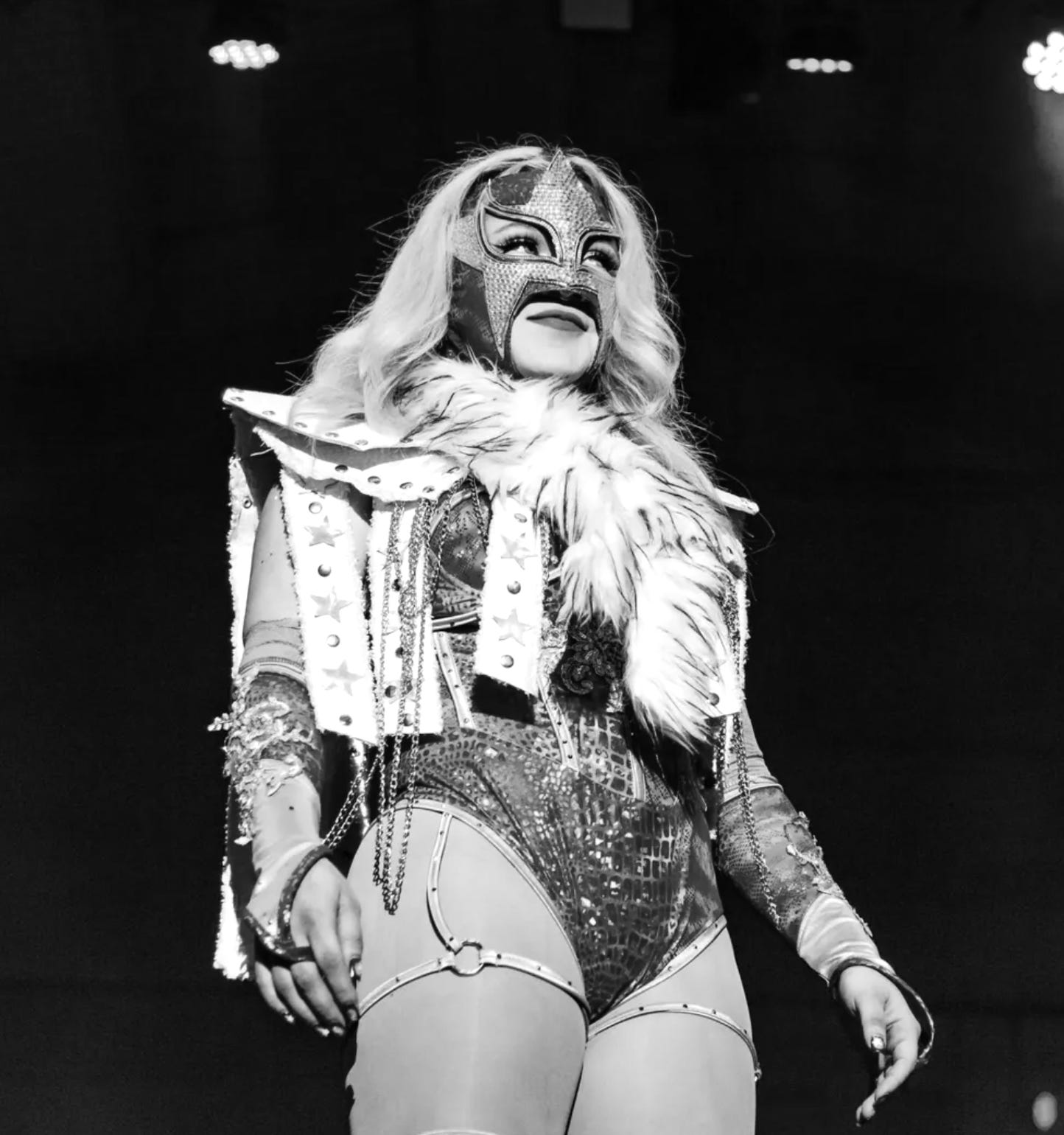
You can watch Kira and know something immediately.
She’s a problem.
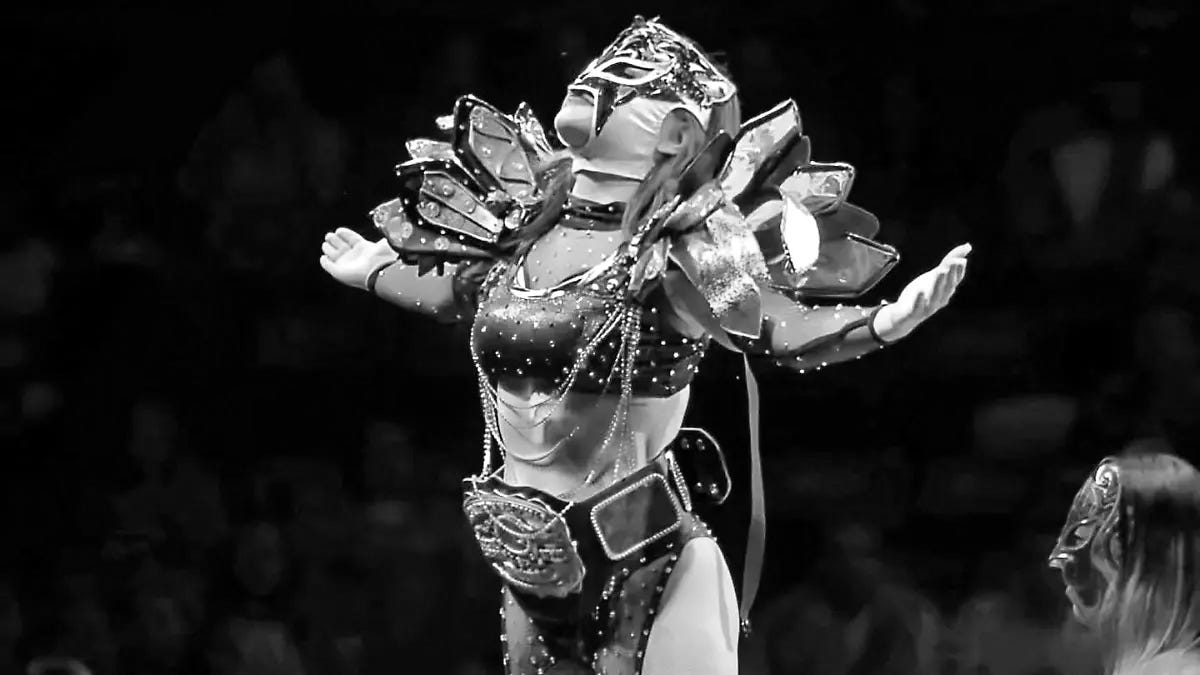
Not a problem like a difficult worker. A problem like “this person is going to be a star, and whoever fails to figure that out is going to spend the next decade explaining why they let it happen on their watch.” It’s the feeling I get every time I watch her. She has an aerial vocabulary built across fourteen years of competition. She has the ability to make a live crowd feel the setup before the move lands. You stop what you’re half-doing and actually watch.
Let me be precise about why I think she’s special, because calling her a “promising prospect” doesn’t cover it. Kira is twenty-five years old and has been doing this since she was a child — the daughter of Gran Jefe III, part of the Comarca Lagunera wrestling family La Tribu Lagunera, sister to wrestlers, raised in the business and trained inside it. Her ability isn’t a learned imitation of someone else’s style. It’s her native language, built over a decade of competition, and refined through hundreds of matches on every kind of show.
She is, based on my research, one of a small handful of luchadoras doing a 450 splash as a legitimate finish, and she’s doing it with the credibility that comes from a crowd that believes it means something. The Cagematch community notices it, too. Over a year ago, a user wrote, “One of the most promising talents in CMLL women roster right now. With tons of potential and one of the most interesting movesets in CMLL’s women division… it’s about time that she becomes really something else.”
It’s about time.
That was thirteen months ago. She is still waiting.
This is not really a story about one wrestler being underused, though it is that. It’s a story about what one wrestler’s usage reveals — about a division that has never been a priority, a development model that keeps producing the same outcome, and a deadline that has never existed before now.
A Division That Was Never the Priority
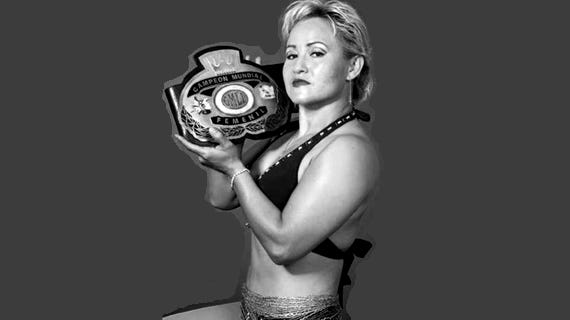
The honest version of CMLL’s relationship with its women’s division has to start here: it has never been the priority.
This is documented history, not a hot take. After Lady Apache’s departure in 2000, women’s wrestling in CMLL entered a period of effective dormancy that lasted roughly five years. When the division revived, it revived largely around Dark Angel — a Canadian wrestler whose work in Arena México generated enough authentic interest that the promotion had to respond to it. The pattern was established early: the division’s credibility would depend, again and again, on forces external to CMLL rather than on any development structure inside the building.
Women’s Month in October and Noche de las Amazonas in March are the products of that history — annual checkpoints that create the impression of commitment without requiring a sustained one. They’re not nothing; they produce real shows with real stakes. But they’re not a pipeline either.
What’s changed in 2026 is the cost of that structural gap. Because AAA is now a TKO promotion, and the talent pipeline TKO has built runs directly through CMLL’s women’s division. The model that papered over the development problem for decades now comes with a deadline it never had before. To understand that deadline, you have to trace what happened to the last four women who carried this division.
The Vaquer Problem
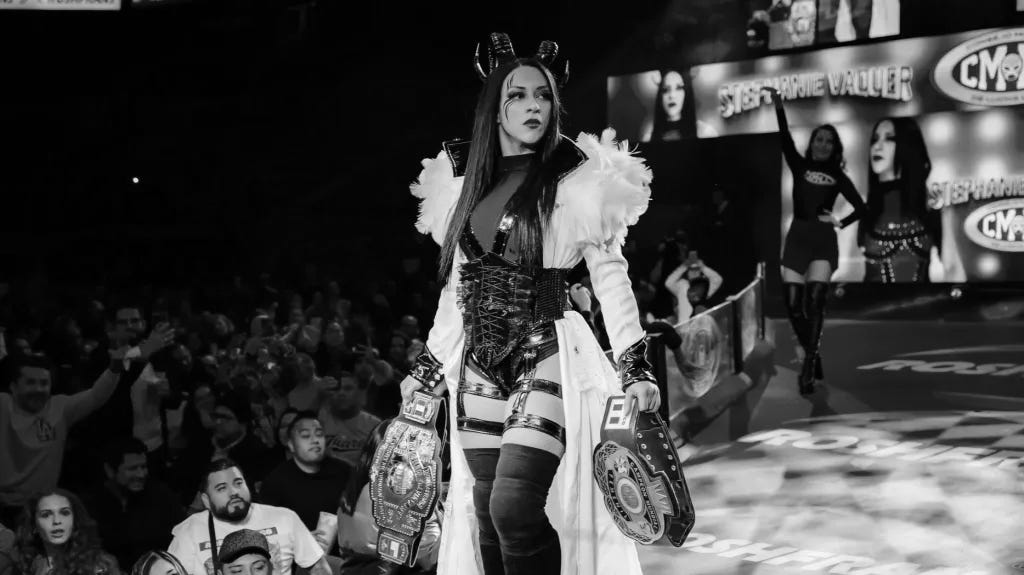
Stephanie Vaquer was CMLL’s women’s division for a sustained stretch. The Campeona Universal. The inaugural World Women’s Tag champion alongside Zeuxis. The reason the title felt like something worth holding during the years she held it. CMLL invested in her consistently, built real feuds around her, and the work paid off: she became the most credible women’s star the promotion had produced in years.
In 2025, NXT signed her.
She is now one of the most discussed women in WWE. CMLL absorbed the loss, changed nothing about how they build and protect their next women’s star, and waited for the next break to arrive.
It arrived in two pieces, almost simultaneously.
The Moné Problem
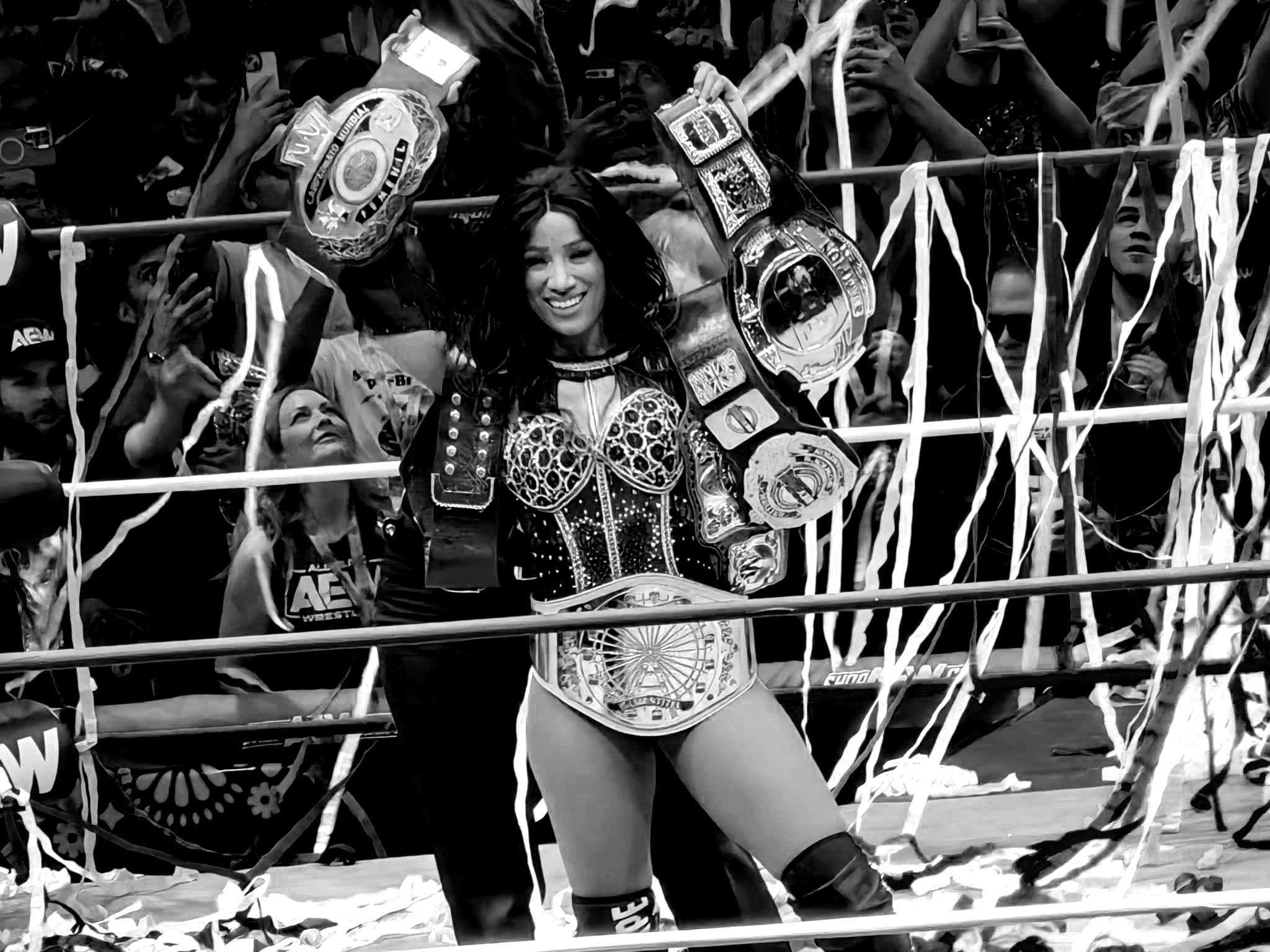
The first piece was Mercedes Moné.
CMLL needed a centerpiece in Vaquer’s absence and solved the problem the way they had solved it before: they borrowed one. Moné won the CMLL Women’s World Championship at Grand Slam Mexico — a co-produced AEW show — defeating Zeuxis, who had been carrying a 278-day homegrown reign. She then held the title for 261 days — eight months, three defenses. Those defenses were against La Catalina at Fantastica Mania Mexico, Persephone at the October 17 Viernes Espectacular during Women’s Month, and Olympia — that last one on AEW Collision, not at a CMLL show.
During those eight months, the belt traveled the world as one piece of Moné’s belt-collector gimmick alongside the AEW TBS Championship, the RevPro Undisputed British Women’s Championship, the EWA Women’s Championship, and titles from Poland, Austria, Denmark, Canada, and Malaysia — a collection that peaked at thirteen simultaneously and broke Último Dragón’s record for the most titles held at once. The CMLL Women’s Championship was one more crown in The CEO’s gimmick.
To CMLL’s credit: when Moné finally dropped the title, she dropped it to a homegrown talent. Persephone had pushed her in that October defense, earned the credibility, and got the shot at Noche de las Amazonas on March 6. CMLL used eight months of borrowed centerpiece to eventually elevate one of their own. The handoff landed.
Which brought its own complications.
The Persephone Problem
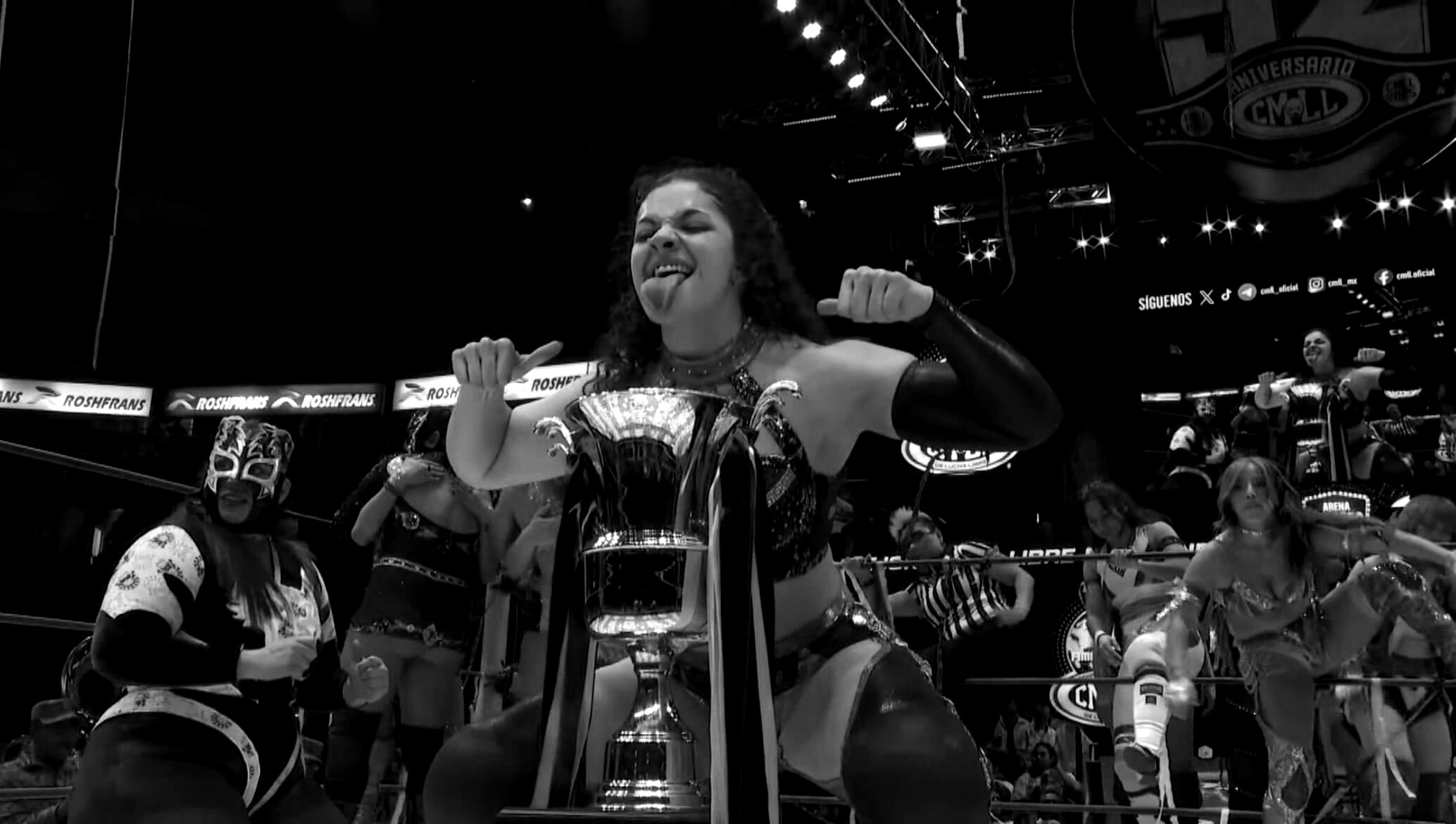
Persephone winning the Women’s World Championship from Moné at Noche de las Amazonas on March 6 was the right call, and CMLL deserves credit for it. She built herself into the most credible contender the division had. The match worked, the crowd was there for it, the finish landed. Of everything discussed in this piece, that decision is where CMLL got it right.
The complication is what happened next, and it’s worth tracing carefully.
Persephone signed a dual AEW/CMLL contract in January 2026. She was, by any measure, a success story — a twenty-four-year-old from El Paso who had built herself through CMLL into someone AEW wanted on contract. On December 5, 2025, three months before she won the title, she was in the main event of ROH Final Battle, challenging Athena for the ROH Women’s World Championship.
She lost.
On March 11, five days after winning the CMLL title, she challenged Willow Nightingale for the AEW TBS Championship on Dynamite — a real moment, the new CMLL champion on national television.
She lost on a backslide.
Then, on the April 22 Collision tapings in Portland, her team lost to Skye Blue and Thekla after Julia Hart blew black mist into Persephone’s eyes, with Blue getting the pin.⁷ Dave Meltzer reported in the Wrestling Observer that the mist finish was a storyline cover for a genuine injury Persephone had been dealing with — and that prior to the injury, AEW had been planning a Women’s World Title match between Persephone and Thekla at Double or Nothing.
The picture this paints is more complicated than “CMLL’s champion is thriving in AEW.” Persephone is positioned strongly and clearly valued by both promotions. She is also, on her AEW record this year, 0-for-every-major-singles-opportunity she’s been given. The CMLL Women’s World Championship spent 2026 as a prop in an AEW storyline that was going to pay off in an AEW Women’s World Title match — a match that didn’t happen because she got hurt. The belt has not anchored a CMLL narrative in months. The champion’s story belongs to another company, and it didn’t even resolve in her favor there.
Putting the title on Persephone was right. The structural problem isn’t the decision — it’s that the decision immediately fed into the same pattern as every decision before it. Another star made in Arena México, another story told somewhere else.
The Catalina Problem

La Catalina is the cautionary tale. Not as a story that ended badly for her — it didn’t, she’s thriving in AAA and the future is bright — but as a story that ended badly for CMLL. Because CMLL had everything it needed with Catalina, let it slip away through a combination of structural neglect and borrowed-talent overcrowding, and is now positioned to do the exact same thing to Kira. The playbook is identical. The clock is running faster.
Catalina came up in WWE, working NXT from 2019 to 2021 under the name Carolina against the likes of Bianca Belair, Candice LeRae, and Xia Li. The night after her November 2021 release, she posted on social media under her WWE name, Katrina Cortez:
“At 18 I made the decision to travel to an unknown country, without knowing English I came here… today I receive an email telling me that my visa expires next month and I will have to sell everything that with much love and effort I have achieved.”
Thirty days’ notice. Everything she’d built, sold.
In a 2022 interview with POST Wrestling, she described the real cost of that period — the pressure to meet WWE’s body standards, the physical toll she paid trying to conform, the online criticism that came anyway, most of it from fellow Chileans. “I felt the weight of being the first Chilean,” she said, “and I felt that I was doing it wrong, but now I see it and I know it was not like that.” She was pragmatic about the release itself — she’d seen the mass layoffs coming and assumed she was next. The worst part, she said, wasn’t the firing. It was that her father had flown from Chile to visit her, and was on a plane home the same day she got the call.
There’s an irony buried in that WWE tenure. The person who told her about Mexico, about AAA, about CMLL — who became something like a wrestling father figure to her at the Performance Center — was Santos Escobar. The system that ultimately discarded her was also, in a roundabout way, the system that pointed her toward where she’d end up.
After leaving, she told POST Wrestling:
“I think I already fulfilled my dream, which was to be in WWE, and I still haven’t found the next one. But I would like to go back to wrestle abroad.”
She went home to Chile, rebuilt, and eventually landed at CMLL in 2023 — not through any pipeline the promotion built. As thecubsfan — who runs luchablog at thecubsfan.com, the most thorough English-language record of CMLL results in existence — noted after her departure, she arrived “because Sarah Stock and Taya Valkyrie pointed her toward CMLL.” CMLL caught a break and capitalized on it: the Campeona Universal, a years-long rivalry with Vaquer that gave the division its best sustained heat in years, a title match against Moné at Fantastica Mania 2025 in front of a full Arena México.
Then the AEW working relationship expanded, AEW women began filling out CMLL cards with more frequency, and Catalina’s positioning compressed. Title matches became mid-card tags. Mid-card tags became curtain. Her contract expired April 1. She didn’t renew. CMLL announced the split April 7.
On April 11 she arrived in AAA in a pink car and crashed Flammer’s Reina de Reinas celebration. Immediately positioned as the next title challenger.
This is a woman who left WWE because it wasn’t giving her opportunity, who said publicly she wanted to wrestle abroad again — and who, when the authentic lucha promotion stopped making room for her, walked back toward the WWE ecosystem because it was. She didn’t go back for the brand. She went back for the booking. The “authentic lucha” argument has a hard time competing with a pink car entrance and a title shot on week one. The wall is still the wall whether or not it’s properly plastered.
“Catalina was a young person who felt young in a promotion that likes feeling old and a women’s division that is even older,” thecubsfan wrote the morning after her departure. She was, he said, “wallpaper over a CMLL problem that still isn’t fixed.”
The wallpaper is in AAA now. The wall still needs fixing.
And in the same post, Cubsfan added the sentence that should be printed and pinned somewhere in CMLL’s booking office: “You can see her influence on Skadi and Kira, and part of that is why I think Kira is the next logical WWE target.”
CMLL has seen this play before. The question is if they care enough to stop it.
Who is Actually Being Featured
The mechanism that compressed Catalina is still running. You can read it off the 2026 cards.
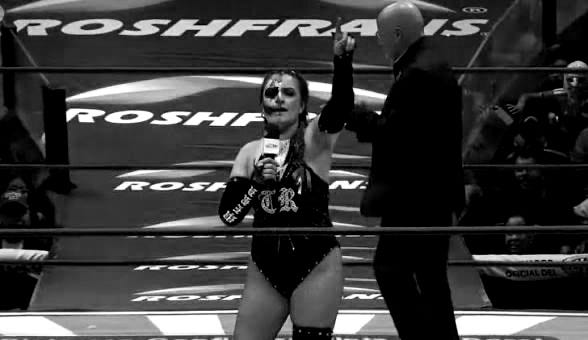
CMLL’s women’s division is currently topped by Persephone, who holds the World Women’s Championship and a dual AEW contract. Below her: Thunder Rosa, who signed her own dual AEW/CMLL contract on April 3 and has appeared at Arena México-level shows eight times in the ten weeks since — Friday Espectaculars, the 83rd Anniversary of Arena Coliseo, Saturday Coliseos, Domingo Familiars. Alongside Rosa: Las Chicas Indomables (Lluvia and La Jarochita), the World Women’s Tag champions, who are in everything. Zeuxis, who won the Copa 70. Aniversario De La Arena México De Amazonas in April — an eight-woman tournament at the biggest show CMLL ran in the first half of the year — and then won the Torneo Internacional De Amazons in Guanajuato in June. India Sioux, the CMLL Japan Women’s Champion, who appears in every meaningful tournament. And Tessa Blanchard, who is — worth noting — not even under CMLL contract, a TNA talent who has been taking bookings since October 2025, and who as of this week received her TNA release amid the ongoing cross-promotional cold war. Blanchard got a spot in that Copa 70. Aniversario tournament. She got a title shot against Persephone over WrestleMania weekend.
That is the division’s top tier: two dual-contract AEW signings, the tag champions, the year’s most decorated tournament winner, the Japan champion, and an unsigned outside worker collecting tournament spots and title matches.
And then there is Kira, the woman CMLL chose to send to Japan first.
Before her Stardom debut, she told Fightful: “I have a lot of weight on my shoulders, a lot of positive energy. If I didn’t have nerves, it would mean that I no longer love wrestling. I love wrestling with all my heart, so nerves will always be there.”
She went to Japan carrying that. India Sioux, Kira & Tabata defeated God’s Eye in 10:36. She came home to the opening match of Noche de las Amazonas — below Mina Shirakawa, below Megan Bayne, below Starlight Kid and Mei Seira, all guests from the partnerships she had just been sent to legitimize. On March 14, she traveled to Atlanta for an MLW taping and challenged Shotzi for the MLW Women’s World Featherweight Championship. She took the clean loss, putting Shotzi over ahead of CMLL vs MLW at Arena México. When CMLL vs MLW ran on May 1, Shotzi defended that title against Garra Negra.¹ Kira was not on the card. On April 27 in Puebla, she and India Sioux beat Lady Frost and Shotzi clean in a tag match. She beat the visitors who got her Arena México slots, in a building where it didn’t count, and the booking the following week was unchanged.
She was not in the Copa 70. Aniversario Amazonas tournament — the night before it ran, she lost to Candela, Metálica, and Princesa Sugehit at the Martes Populares. She was not in the Torneo Internacional De Amazons. She was absent from the Copa Dinastias, which is a second-generation tournament, built around wrestling bloodlines — and the daughter of Gran Jefe III, part of La Tribu Lagunera, qualifies by definition. That’s not an oversight born of eligibility. She simply wasn’t entered.
Her Arena México Friday Espectacular record in 2026: four appearances, 2-2, third match every time. Thunder Rosa’s Arena México-level record in 2026 since signing in April: eight appearances in ten weeks.
Candela — who was one half of my WON vote for worst match of the year — has pinned Kira three times this calendar year. January 24. May 30. June 15.
The critique people use to justify all of this is the honest one: she’s still rough. Thecubsfan, after a recent match, noted that she “had a first fall sequence where she looked awesome and then badly blew the springboard to end the run” and that she’s “stuck at 90% of the way there.” That’s accurate. The last 10% is a real gap.
However, I believe Kira at 90% is better than most women in this division at 100%.
And that final 10% is a polish problem. Polish problems close in high-stakes matches against quality opponents with real consequences attached. They do not close in Puebla against Candela while a dual-contract AEW import collects eight straight Arena México appearances.
The Clock Is Ticking
Every pattern described in this piece — the talent built and then taken, the borrowed prestige, the contracted star looking elsewhere — has accelerated under the TKO relationship. AAA is not a distant competitor now. It is a funded, staffed, connected pipeline with a recent track record of identifying and signing exactly the kind of talent sitting on CMLL’s mid-card. It signed Vaquer’s rival. It signed Catalina.
Cubsfan’s observation — that Kira is the next logical target — is not a dramatic prediction. It is a reasonable inference from a visible pattern, made by someone who watches every show and has no investment in hyperbole.
The paths available from here are knowable. The Catalina path: TKO calls, Kira leaves, AAA positions her as a star on day one — which, given what just happened with Catalina, is exactly what they should do. The Persephone path: external attention forces a dual contract, her story splits between two promotions, and CMLL gets the credibility of her name while someone else builds the narrative — and as Persephone’s own 2026 shows, that doesn’t even guarantee the talent wins. The current path: the holding pattern continues, she collects more losses to Candela, and one of the first two paths eventually claims her anyway.
The other path that benefits CMLL requires CMLL to move first.
Kira wants to be here. She walked out of AAA in September 2023 — no negotiation, no counter-offer play — because CMLL was where she’d said she wanted to be since she was nineteen years old. She has a lineage in this business and chose this promotion inside it. She is still choosing it, against a booking sheet that gives her three losses to Candela and four Friday appearances in six months.
This does not require CMLL to rebuild its women’s division from scratch or confront ninety years of structural deprioritization in one season. It requires one thing: give her a program. A real program — a real opponent, a real feud, a story with a direction. Enter her in the Copa de Amazonas. Put her in the Friday match that counts, not the one that fills time. Let the Arena México crowd build the relationship with her before someone in TKO’s talent pipeline takes a meeting.
She is twenty-five years old. She has been doing this since she was a child. She won in Japan, took a title loss in Atlanta in service of someone else’s positioning, beat that someone else in a tag match in Puebla the following month, and showed up for work the next week without a word about any of it.
She is still here.
But she might not always be.