


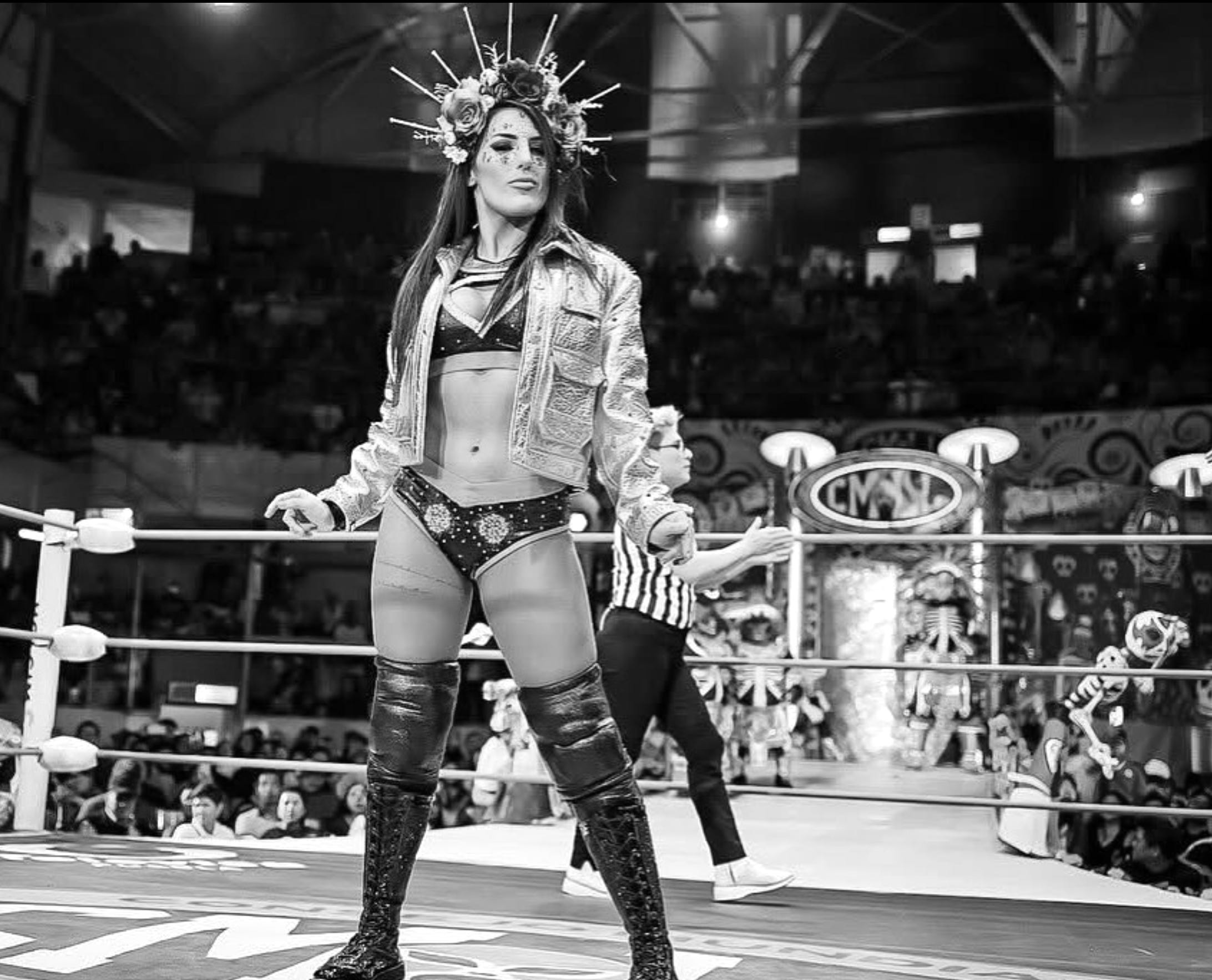
Okay, so, the tree.
We have to start with the tree, because the spreadsheet will tell you almost everything about Tessa Blanchard’s place in CMLL right now, but it cannot explain the tree.
December 2025. Arena México has been dressed for Christmas. Fake snow on the portico. Ornaments painted with the masks of the roster. A Douglas fir standing in the Cathedral, ninety-two years of lucha libre history hanging from its branches like tinsel.
The broadcast goes out on YouTube and Facebook. Wrestlers file through for interviews and keep getting asked about ensalada de manzana—apple salad—because in Mexico at Christmas there is always apple salad. It becomes the running joke of the stream: a procession of enormous, violent people getting sentimental about dessert.
Then the host announces her.
Ha llegado la gringa más mexicana.
The most Mexican gringa has arrived.
Tessa Blanchard steps into the frame beside Esfinge and says the thing that has become her public grammar in CMLL: that walking down these stairs and standing in this building feels like coming home.
Yo amo México y México me ama.
I love Mexico, and Mexico loves me.
Then the remote comes out. One button, red. Salvador Lutteroth, CMLL’s president, stands at the center of the roster. Masks, sweaters, title belts. The countdown begins.
Diez, nueve, ocho.
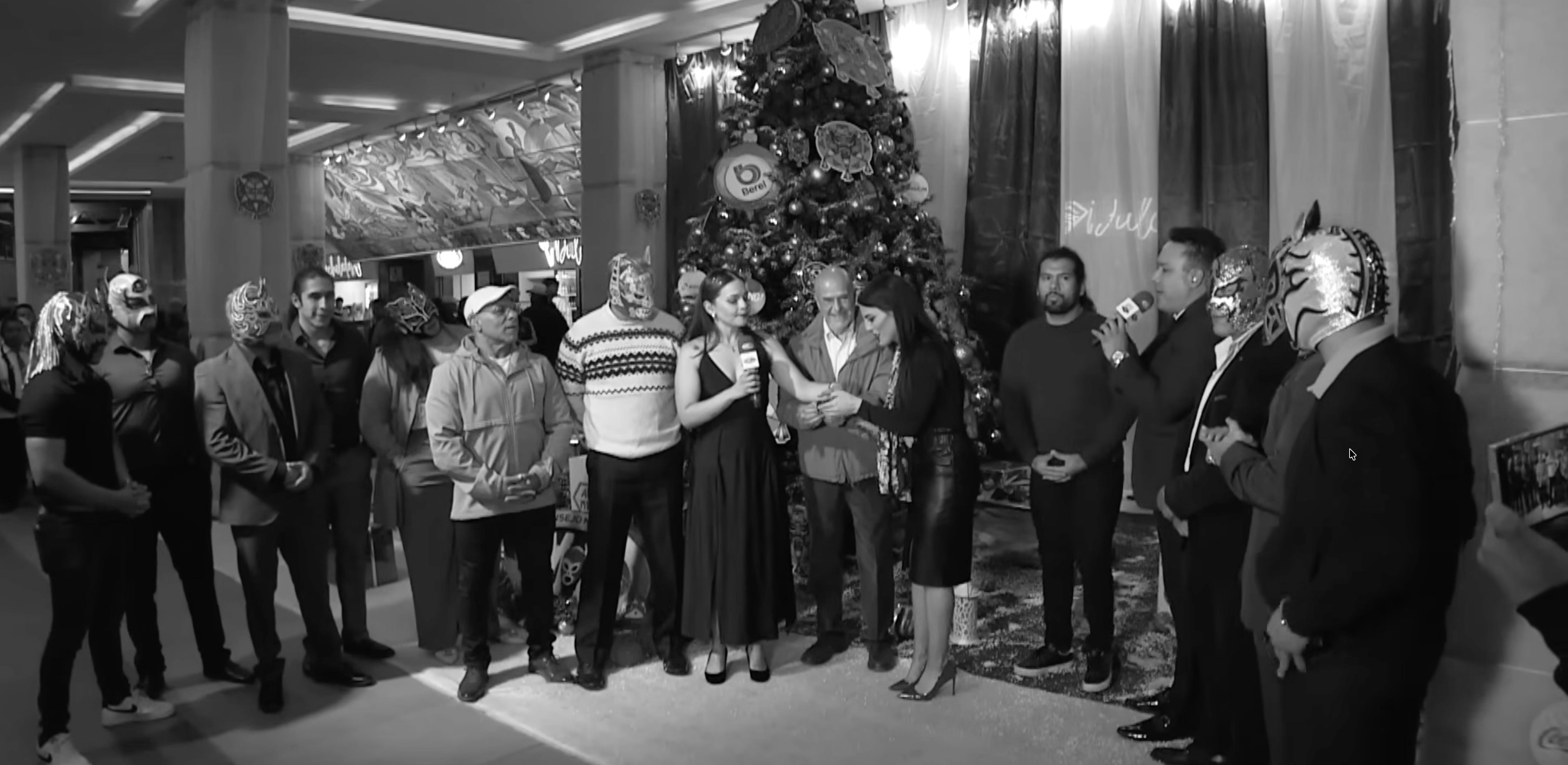
Tessa’s thumb goes down on the button.
The tree came alive. The crowd cheered. CMLL had itself a Christmas card.
It also had itself a metaphor.
One woman. One switch. Every light at once.
By then, CMLL’s investment in Tessa was already obvious. What has happened since has removed any remaining subtlety. She has been introduced, protected and promoted less like one of the Amazonas than as the woman around whom the Amazonas are being arranged.
On Friday, she challenges Persephone for the CMLL World Women’s Championship in Arena México.
The question is not whether Tessa can credibly win it.
She can.
The question is whether CMLL understands the difference between making Tessa Blanchard its champion and making Tessa Blanchard its women’s division.
Because those are two different decisions.
The Part the Spreadsheet Can See
The numbers are almost comically straightforward.
Through July 24, Tessa is 32–9 across 41 tracked CMLL matches in 2026. She is tied with Lluvia for the most wins among the Amazonas and owns the best winning percentage of any woman with at least 20 appearances. She has been on the winning side in 13 consecutive tracked matches.
This is not the résumé of a challenger who caught fire for three weeks so the promotion could manufacture a title match. It is the résumé of a champion waiting for someone to hand her the belt.
Persephone, by comparison, is 15–10 in 25 tracked CMLL matches. That record is not bad, particularly for a ruda working a schedule filled with tags. But it does tell us something about the hierarchy CMLL has been establishing. Tessa has not merely been winning more frequently than the champion. She has been present more often, protected more carefully and positioned more deliberately.
Still, the spreadsheet only gets us so far.
Lluvia has 32 wins too.
Same number. Forty-two matches to Tessa’s forty-one. By any measure the spreadsheet can produce, the two of them have had the same year.
CMLL did not ask Lluvia to light the Christmas tree.
That is the entire problem in one sentence, and it is worth sitting with before we go any further. If this were purely a question of production, the promotion would be choosing between two wrestlers with identical output. It isn’t choosing between them. It hasn’t been for months. One of them is a lifer, a homegrown star, one half of the reigning tag champions, married into the company’s history. The other one arrived from outside, left once already, and came back—and she is the one the company put in front of the tree, in the promotional images, at the center of the roster.
Numbers can make the case for a championship. They cannot explain why a company chooses one wrestler to symbolize an entire division.
For that, look at Persephone.
Persephone is not absent from CMLL. She works Arena México. She has been in the program with Tessa all summer. But the shape of her year is unmistakable, and one detail states it more plainly than any argument I could build around it: in May, she did not wrestle a single tracked CMLL match. Not a light month. A month.
The geography of her title reign says the rest.
Persephone won the belt from Mercedes Moné in Arena México on March 6. Her first defense came against Lacey Lane on an ROH taping in Jacksonville. Her second came against Tessa at CMLL’s Las Vegas event. Her third came against Billie Starkz on AEW Collision in New Mexico. Friday will be her first defense inside Arena México since she won the championship there nearly five months ago.
Meanwhile, her most visible singles progression has happened in AEW. Six days after beating Mercedes, she challenged Willow Nightingale for the TBS Championship. She entered the Owen Hart tournament. She beat Julia Hart in a TBS title qualifier. She wrestled in the six-way to crown a new champion. Even the Starkz defense was framed partly as a step toward Persephone becoming a double champion in AEW.
And it is still happening this week. Days before she defends the CMLL World Women’s Championship in Arena México—her first defense in that building in nearly five months—Persephone challenges Maya World for the AEW TBS Championship.
Read those two bookings in sequence, because CMLL essentially has to. In the same week, the reigning CMLL World Women’s Champion is chasing another company’s television title and finally defending her own at home. One of those matches advances her story. The other one resolves a program CMLL has spent the summer building.
That does not make her disloyal. It makes her a modern dual-company wrestler.
But it does clarify what the championship has become, and the answer has less to do with Persephone than with the belt itself.
In AEW, “CMLL World Women’s Champion” functions as a credential. It is the phrase that establishes Persephone as a plausible threat to AEW gold—the international bona fide that makes a TBS title challenge feel earned. The title is doing narrative work. It is simply doing that work in service of a story that resolves on somebody else’s television, for somebody else’s audience, toward somebody else’s championship.
This is the part that should worry CMLL, because it has happened before, and recently, and worse.
Zeuxis held this championship for 278 days—a long, homegrown, Arena México reign, the kind that builds a division. It ended at Grand Slam Mexico, a co-produced AEW show, when Mercedes Moné took the belt. Moné then held it for 261 days and three defenses, one of which happened on AEW Collision rather than a CMLL card. During those eight months, the CMLL World Women’s Championship traveled the world as one item in a belt-collector gimmick that peaked at thirteen simultaneous titles. It was not the prize. It was an accessory. A crown in The CEO’s collection.
CMLL’s answer to that was correct, and worth crediting: when Moné finally lost the belt, she lost it to a homegrown talent. Persephone had earned the shot, and she won it in the Cathedral, in the main event of the promotion’s biggest all-women’s show. The handoff was the right call.
It also did not solve the underlying problem, because the wrestler CMLL elevated had already signed a dual contract in January. The belt came home in March and started commuting again almost immediately.
So trace the last two years of this title and what you find is not disloyalty on anyone’s part. It is a championship whose meaning keeps getting determined somewhere other than the building it belongs to. First as a collector’s item. Now as a credential. In both cases, the story that gives the belt its significance in any given month is a story CMLL is not writing.
That distinction matters more than the win-loss record.
CMLL has a world champion. What it has not had, for a while now, is a world championship whose meaning it controls.
The Belt Has Always Had A Passport
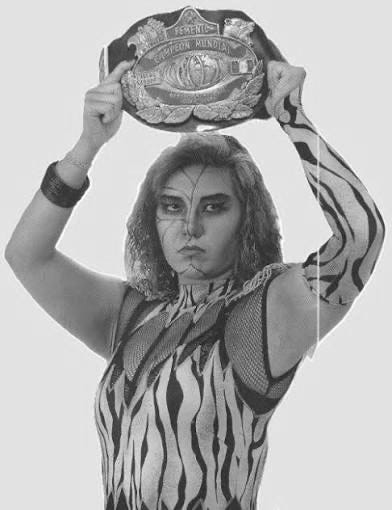
Before anyone gets too precious about CMLL potentially putting its women’s world championship on a gringa, it is worth opening the title history.
The first CMLL World Women’s Champion was Bull Nakano.
Not the first foreign champion. The first champion, period.
The title has since been held by Akira Hokuto, Mariko Yoshida, Hiroka, Syuri, Panama’s Dalys la Caribeña, Chile’s Stephanie Vaquer, Willow Nightingale and Mercedes Moné. Its recent lineage has moved from Vaquer to Willow to Zeuxis to Mercedes to Persephone.
The “World” in the championship’s name has frequently been literal. Foreign champions are not an intrusion into this belt’s history. They are part of its grammar.
A Tessa victory, then, would not represent some radical Americanization of the Amazonas. Willow and Mercedes have already held the championship. Persephone herself is Mexican-American. CMLL’s women’s world title has often functioned as the promotion’s passport belt: the championship most comfortable crossing borders, appearing in other promotions and connecting Arena México to women’s wrestling elsewhere.
The historical problem has not been nationality.
It has been control.
In 1996, CMLL stripped Akira Hokuto after she appeared on WCW Monday Nitro. In 2024, Stephanie Vaquer was stripped when she left for WWE. Willow then won the vacant title in San Jose. Mercedes won it on an AEW show co-produced with CMLL. Persephone’s first three defenses have occurred in Jacksonville, Las Vegas and Rio Rancho.
The belt traveling is part of its identity. The belt repeatedly becoming entangled in another company’s plans is part of its history too.
CMLL has spent the last few years confronting a basic problem: the more internationally valuable an Amazona becomes, the harder it may be for CMLL to keep her story centered in CMLL.
Tessa offers a possible solution.
And this is where the argument becomes uncomfortable.
To my eye, Tessa is not especially likely to receive the call from WWE or AEW. Nothing in wrestling is permanent, and no one outside those companies can know what they will do. But they have had years, multiple free-agent windows and plenty of opportunities to sign her. Neither has.
Readers of this project know why. There is no need to retry the entire case from 2020 every time Tessa’s name appears. The history is known. So are the allegations, the denials and the reasons her name remains radioactive in certain parts of the industry.
At some point, though, the absence of a call becomes evidence.
That gives Tessa a peculiar kind of value to CMLL. She possesses the résumé, name recognition and in-ring ability of a wrestler who should be attractive to either American giant, but she carries baggage that makes both companies reluctant to touch her.
Her limited market elsewhere begins to function like exclusivity.
This is not theoretical. Tessa has already shown CMLL that she can leave. In December 2024, she departed for TNA while holding the CMLL World Women’s Tag Team Championship with Lluvia, forcing the promotion to vacate the belts.
CMLL’s answer to that, when she came back, was to book the betrayal directly. Her first match on returning—October 10, 2025, Arena México, eleven months after walking out—was a singles match against Lluvia. Not a soft landing against a stranger. The partner she left holding the bag, on night one, in front of the building that remembered.
That should tell you how deliberate this has been from the beginning. CMLL did not stumble into a Tessa Blanchard push. It walked her back through the exact door she had slammed, with the exact person she had slammed it on, and let the crowd decide in real time. The crowd cheered her. The company has been building on that answer ever since.
The more recent evidence points the same direction. When TNA asked her to choose between TNA and CMLL this summer, Tessa says she chose CMLL. She said her life was in Mexico. She called herself the Mexican gringa.
Both facts belong in the evaluation.
Tessa left CMLL holding a championship.
Tessa later chose CMLL over the company she left it for.
That does not make her unpoachable. It does make her a safer bet than a champion whose career is increasingly being integrated into AEW television.
CMLL may have found a market inefficiency: an elite wrestler whom the two richest companies in the United States appear unwilling to pursue.
Sports teams build contenders this way all the time. A player becomes available because every other organization is scared of the injury history, the personality, the contract or the headlines. One team decides the production is worth the risk. Sometimes that team looks smarter than everybody else.
Sometimes it becomes so invested in proving everybody else wrong that it stops noticing what the player is costing it.
That is the line CMLL is walking.
The Risk Begins After The Win

If Tessa wins Friday, I will not call the decision indefensible.
Her results justify it. Persephone’s increasingly AEW-centered trajectory helps justify it. A gringa wearing this particular belt is not a violation of CMLL tradition—the title history settles that.
The risk is everything CMLL might ask the victory to mean.
Tessa is not being presented as an American ruda who arrived to steal a Mexican championship. CMLL has wrapped her in the language of belonging. It has made her commitment to Mexico part of the product. It has placed her at the center of public events and promotional imagery. It has encouraged the idea that this is not simply a successful foreign wrestler, but someone who has finally found the country and company that understand her.
That is a larger endorsement than putting a belt around her waist.
It turns every match into another chapter in the rehabilitation of Tessa Blanchard. Every opponent risks becoming a supporting character in that story: the woman who challenged Tessa, the woman who validated Tessa, the woman Tessa elevated, the woman who eventually proved worthy of succeeding Tessa.
The division stops generating stories of its own. It becomes one long story about her.
That is what it means to make someone the division.
And we already know what that costs, because this project has spent a year documenting the other end of it. The reason CMLL needs a Tessa Blanchard is that it has never built a reliable structure for developing and keeping its own women. Vaquer left. La Catalina walked. Kira—twenty-five years old, second-generation, arguably the most talented young Amazona on the roster—has spent this year losing to Candela and working third from the top on Fridays while imports collect the featured slots.
A division that cannot develop its own answer will eventually buy one. That is not a moral failure. It is a structural one, and Friday is what it looks like when the bill comes due.
The danger exists even if Tessa does everything right.
She can be dependable. She can have excellent matches. She can honor her commitments. She can make CMLL’s gamble look brilliant. None of that changes the structural risk of allowing one wrestler to become the division’s identity, drawing card, international résumé and proof of concept all at once.
CMLL does not need to choose between using Tessa and protecting the division from dependence on her. It can put the championship on her and still build opponents who possess identities independent of her. It can use her name to create new stars without making proximity to Tessa the only measure of their importance. It can let her stand at the center without allowing everyone else to disappear into the background.
It can, in other words, put the belt on Tessa Blanchard and put Kira in a real program in the same month.
But that requires CMLL to understand why this relationship works.
Tessa did not become the most valuable Amazona merely because Mexico recognized something the United States failed to see. She also became especially valuable because the largest American companies have apparently decided the risk is not worth taking.
For CMLL, that creates opportunity.
It does not erase the risk.
Friday night, Tessa Blanchard may become CMLL World Women’s Champion. If she does, the booking will be easy to defend. The numbers are there. The history is there. The opponent’s trajectory is there.
The real test begins Saturday morning, when CMLL has to decide what exactly it crowned.
Last Christmas, the company placed one red button in Tessa’s hand and every light in the plaza answered.
That is a beautiful way to light a tree.
It is a dangerous way to wire a division.