


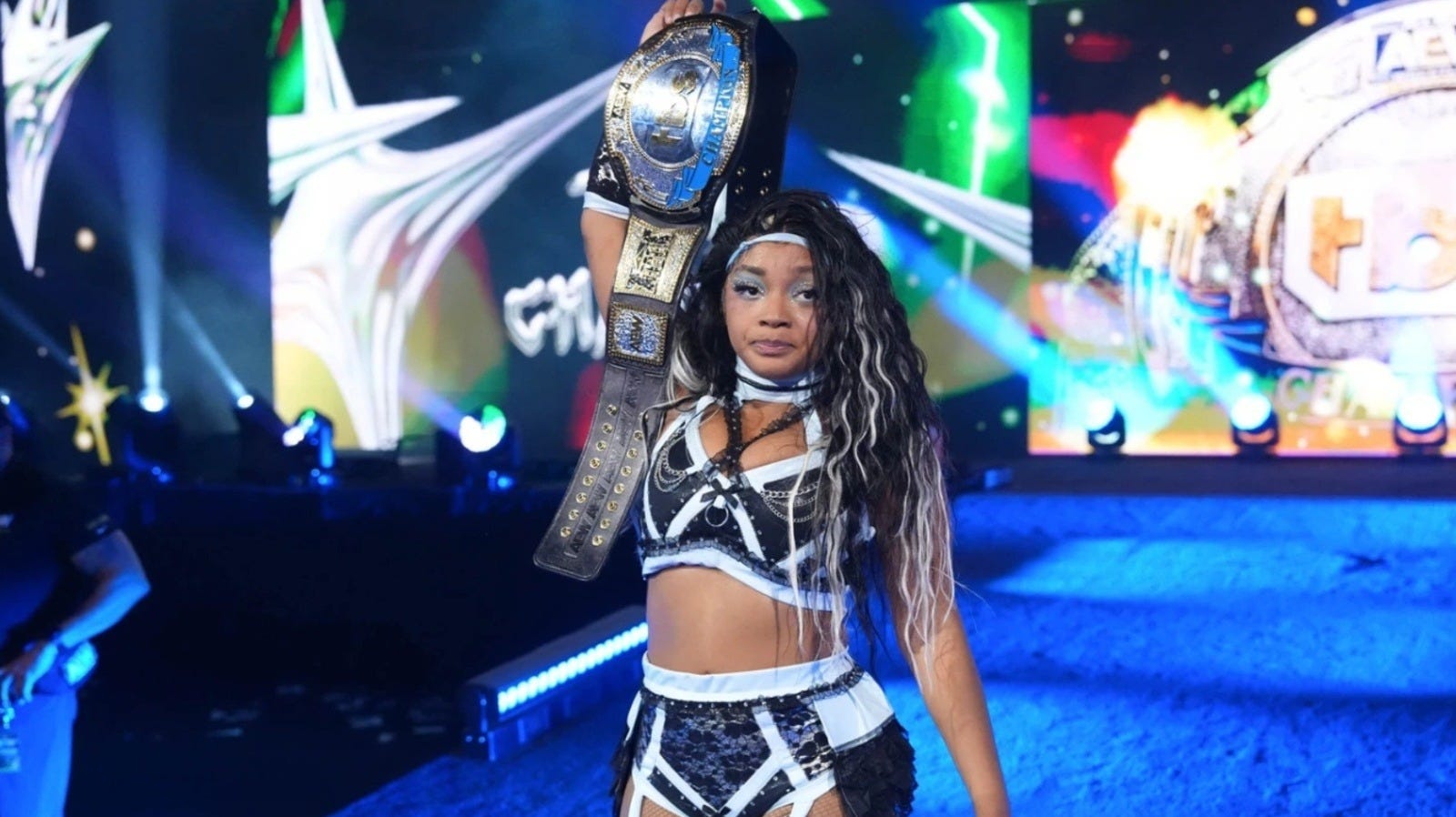
Maya World turned 24 on July 26. She also beat Hikaru Shida for the TBS Championship, which meant wrestling fans spent the next morning doing one of the things they do best: admiring a lovely moment, disliking the match, then finding a number to make the disagreement official.
The moment was wonderful. The match was not.
It ran too long and lost its rhythm. Shida appeared to be struggling, and the match eventually asked Maya to solve problems she does not yet know how to solve. Dave Meltzer gave it 2.25 stars. Cagematch users had it at 5.46 at the time of this writing. Even most sympathetic reviews arrived at roughly the same place: great moment, poor match.
AEW may have moved too fast, and we will not know for a while.
For now, that conclusion leaves most of the story out because Maya World is not a finished wrestler. Nor should she be. She is 24 and debuted les than four years ago. Wrestling fans can be strangely offended by the discovery that a 24-year-old is still 24.
AEW has identified a young wrestler who can already make a building want something for her, put a championship on that connection and chosen to let her learn the rest where everyone can see it. The company is developing its champion in public.
I think AEW may be too early with Maya.
But I do not think AEW got it wrong.
I expect her to become one of its top women and someone the company can build major programs around. The awkward part is that we are going to see the distance between here and there on television.
Her AEW career has changed twice because she answered a call intended for somebody else. In November, Maya and Hyan stepped into a Collision match against TayJay on short notice. They lost, came back for more dates and were still winless in AEW when Tony Khan signed them after the Worlds End preshow on Dec. 27.
Six months later, Sareee could not compete in the Owen Hart Cup. Maya got another call to step into a spot not originally intended for her.
She entered the tournament, upset Skye Blue and then pinned Athena, her trainer and mentor, in the semifinal. Less than three weeks after entering as a replacement, she stood across the ring from Mercedes Moné in the final at Forbidden Door.
Her rise has looked less like a rocket and more like the career of someone who keeps a bag packed. AEW did not carefully map every stop. The route changed, and Maya kept being ready when it did.
Where you think Maya World came out-of-nowhere depends on where you’re looking. Cagematch lists 211 Maya World matches, although its record begins months after her stated debut and is not complete. She held independent championships, worked constantly and kept training while AEW viewers knew her, if they knew her at all, as someone who lost to Thunder Rosa or Megan Bayne.
She signed with AEW and became TBS champion less than seven months later. Seven months is barely enough time for one AEW story to survive three schedule changes. For Maya, it covered the distance from unsigned substitute to champion.
In May, Athena told Fightful that Maya had “already surpassed where I was” at the same age. She remembered Maya worrying that a Fort Worth crowd would not react to her, then walking through the curtain to an eruption. Athena considers her must-watch now and wonders what she might become in two, five or 10 years.
Athena helped train Maya. Khan signs her checks and chose to put a belt on her. Neither is a neutral witness. Their praise is still useful because both keep returning to the same qualities: Maya listens, prepares, delivers and connects with people. Wrestling calls that last quality the “it factor,” which is what we say when we can feel something but would prefer not to complete the paperwork.
Maya is easy to root for without spending every second insisting that you root for her. She moves with speed, but her compact power is what tends to surprise people. A run of fallaway slams against Moné became a crowd rally. Her selling keeps the emotional direction of a match clear even when the sequence connecting two moments does not.
Moné was not only the right opponent for this story. She was the wrestler who made Maya want to do this. Maya has said that watching Sasha Banks in 2015 made her want to wrestle. Their Owen final lasted nearly 25 minutes. The beginning was rough. There were gear problems, awkward exchanges and stretches when Moné’s experience was plainly holding the match together.
Then they found the crowd.
Maya sold from underneath, kept creating a little more hope and reached a finishing stretch in which an outcome almost nobody expected briefly felt possible. She lost, as nearly everyone assumed she would. The crowd had still traveled somewhere with her. As of Aug. 3, Cagematch users have the match at 9.08 from 651 valid votes.
Meltzer attended the show and did not publish a rating. He wrote that the match felt different live and that he wanted to watch the television version before assigning a number. As of Aug. 3, that number has not appeared. Moné eventually joked that Khan should send him the link. This became a small wrestling emergency because we are quite capable of staring into an empty Cagematch cell until it becomes a moral crisis.
The blank does not tell us Meltzer hated the match or refused to rate Maya. He gave her semifinal with Athena 4.25 stars, the Shida match 2.25 and her first defense against Persephone 3.5. He rated her before Forbidden Door and after it. One match remains blank. Anything about motive is speculation — and there’s been plenty of that. I’m not here to offer any more.
What I will say is this: Ratings are not lab results, but together these matches reveal a useful pattern. Maya can already participate in something great. She does not yet produce that level from opponent to opponent or rescue a match once it starts drifting. Athena and Moné helped structure matches around a younger opponent, but Maya still had to sell, keep pace, handle the pressure and make the crowd believe. She held up her end in both. Redemption showed how much work remains when an opponent cannot supply that structure. The problem is AEW has many more wrestlers similar to Shida than Mercedes.
Here’s what I’ve noticed.
Maya can pause too long in transitions. You can sometimes see her and her opponent discussing what comes next. Her offense moves among speed, compact power and high-flying without always feeling like one wrestler’s distinct idea. Her character is still mostly the earnest young underdog, which works beautifully when she is chasing Mercedes and becomes harder to sustain when she is the champion being chased.
Most importantly, we do not know whether she can control the pace when a match drifts or help an opponent through a difficult night. Shida appeared to be having one at Redemption. Maya could not find a way to repair the match around her. A champion will eventually be asked to do that.
Three nights later, she had a much better match with Persephone. Meltzer gave it 3.5 stars, and the Detroit crowd stayed with Maya. It was only one match, but it kept Redemption from becoming the only recent evidence.
The people who think AEW moved too fast have a case. A title is not an internship. It asks a wrestler to anchor matches, promos and programs. AEW could have left Maya in ROH, kept her beside Hyan and waited until her floor rose closer to her ceiling. It matters, though, that AEW gave her the TBS title. Willow Nightingale and Mercedes Moné gave the championship weight, and Moné sometimes made it feel like the most important women’s title in the company. It is a meaningful secondary title, capable of carrying a major program without declaring its holder the best woman in AEW.
That makes Lex Luger a useful historical comparison. He was less than two years into his career when he won the United States title in 1987. His physical gifts were obvious. The rest was still under construction. He was placed beside Ric Flair, Arn Anderson and Tully Blanchard, worked with Nikita Koloff and Dusty Rhodes, and held a title important enough to establish him without requiring him to be finished.
Luger never became one of the world’s great technical wrestlers, but he became a top star and a world champion. He did not need to turn into Ric Flair for the United States title bet to work.
Luger shows the range of what this kind of title reign can produce. It gives a developing wrestler meaningful television time, better opponents and consequences while she learns, but it cannot decide the result.
Maya remains an encouraging wager because the evidence keeps changing. Her best nights are no longer hypothetical, and the weaknesses are easy enough to name: pacing, transitions, move selection and recovering when the plan stops working. Those problems will take time and good coaching. Meanwhile, people already care about her, which is the part wrestling schools have the hardest time teaching. She will do the remaining work with a belt on her shoulder and cameras running.
Learning in public would be complicated enough on its own. Maya is also a Black woman receiving a prominent opportunity in a fan culture that has not always extended Black women the same patience.
That does not make every criticism of her racist. The Shida match deserves criticism, and calling a clumsy transition clumsy is simply describing what happened. Taking Maya seriously requires honesty about what is not working. The problem begins when a bad transition becomes evidence that she never deserved the opportunity.
Wrestling already has a familiar vocabulary for young men given secondary championships: prospect, investment, upside. Luger had critics. Sammy certainly did. Their title wins are still legible as bets on the future. Some of Maya’s critics reached for a different word. Under one of AEW’s own posts after she won the championship, one comment read “DEI push.” An earlier clip drew “Quit pushing her due to DEI.” Two comments do not represent a fan base, and it would be dishonest to pretend they do. They establish something narrower: at least some people evaluating Maya have announced a standard that has nothing to do with her footwork.
Black women in wrestling have been describing unequal standards for years. Athena once talked about an independent scene where it seemed there was room for one Black woman per state, as if a promoter could fill a slot and consider the matter settled. In Lyric Swinton’s survey of women working in wrestling media, women described racist and sexist scrutiny, recurring demands to prove they belonged, and harsher reactions to opinions their male peers also expressed. It is not the same job Maya performs, but it is part of the same culture discussing her.
Maya has talked about what representation meant to her as a fan. In 2024, she described how much it meant to see two Black women face each other on an AEW pay-per-view and hoped they would be trusted with the main event. One had inspired her to wrestle. The other, Maya said, had fought for everything she received.
The roster is more diverse than it was when Athena started, but the old habits did not all leave with the old rosters. Young men are often granted time when they are called green. For a Black woman, the same word can become evidence against the push itself. One mistake starts a larger argument about whether she should have been given the opportunity at all.
I am a white man raising a Black daughter. I can tell when a wrestling transition looks clumsy from my couch in Ohio. I cannot tell Maya what it feels like to be a Black woman doing that work on national television. I will never see the world through her eyes or my daughter’s. Raising my daughter has not given me their experience by proxy. Loving her does not make me an authority on what she will encounter. It has made me listen more closely. Mostly, it has shown me how much I do not know.
My wife and I named our daughter after another Black woman who appears on AEW television. Wrestling will be on our television throughout her childhood, whether she requests that inheritance or not. We wanted her to see someone on the screen who looked like her, someone she could grow up watching and perhaps look up to.
That does not make Maya (or any other wrestler) responsible for my daughter’s self-image, and it does not oblige anyone to pretend her bad matches are good. It means I pay attention to who is allowed to appear, struggle, improve and remain visible. If every Black woman on television has to be flawless to stay there, nobody in the division would last long under that rule.
Black women deserve the ordinary span of a wrestling career. They should be allowed to be young, uneven, promising, overpushed, underpushed, rough on Sunday and better by Wednesday. Maya does not need a lower standard because my daughter might watch her. She deserves an honest standard, one that accounts for where she is in her career and does not turn every mistake into a referendum on whether she should be there.
Maya World is not finished, and the title did not change that when Shida stayed down for three. It means the work will happen in front of more people. AEW has given her better opponents, higher expectations and less room to hide. She will have great nights and probably another night like Redemption. She says she still trains every week, and she is going to need every one of those sessions.
Four years from now, we may decide AEW moved too fast. I do not think we will. I expect Maya World to be one of the women the company builds around. We may also look back at this title reign and wonder why so many of us were in such a hurry to decide what a 24-year-old had already become.