


I have never been to Comic-Con.
I want to be very clear about this.
No cape. No foam sword. No waiting in line next to someone in a full Thanos suit while quietly reconsidering my life choices. I want to be very clear about this, because what I’m about to tell you might make you assume otherwise.
I have been cosplaying my entire life.
Just without the lanyard. Without the convention floor. Without even the self-awareness, for most of it, to understand that the person walking into every room was wearing a very carefully assembled costume that had increasingly little to do with whoever was underneath.
Different rooms got different costumes. Different crowds got different versions of me. And I have been doing this for so long that there were stretches — real stretches, not brief confusing Tuesdays — where I genuinely couldn’t tell you which one was the real guy.
Wrestling helped me figure that out. Specifically: Brad Armstrong.
But before we get to brad, you need to understand what we’re working with.
If my professional life were a wrestling career, the booker would have been fired by now.
I have been a shoe salesman. A medical billing specialist. An insurance fraud investigator. A ski resort sales team member — yes, in that order, yes, I understand how that reads.
A band manager. A sports writer.
A digital journalist. An editor (a bad one at that.)
A band manager again, because apparently I needed to confirm that the first time wasn’t a fluke. A publicist. And now, a pastor.
I am, essentially, Forrest Gump with a Substack.
Every single one of those felt, at the time, like the new gimmick that was finally going to stick. New entrance music in my head. Fresh tights. A recalibrated sense of what this particular crowd needed from me and whether I could give it to them fast enough to matter. And every time — every single time — the same guy showed up underneath the costume. The same anxious, approval-hungry, genuinely trying human being who just wanted the room to like him.
We will come back to that guy.
But first: Brad Armstrong.
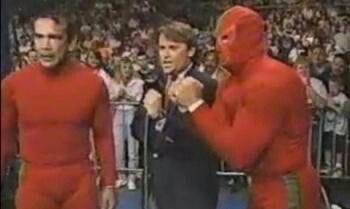
Brad Armstrong was the oldest son of Bullet Bob Armstrong, a working-class hero who spent thirty years being the exact kind of man that wrestling crowds in Alabama trusted without thinking about it. Bob raised four sons with his wife Gail. All four became wrestlers: Brad, Scott, Steve, and the youngest, Brian — Road Dogg Jesse James, D-Generation X, the man who could silence or ignite any arena in America with four words — became legitimately famous.
Despite that, Brad was arguably the most purely talented of the four. Steve Austin once said that going to the ring with Armstrong was like being handed a gift: you never had to say a word, he already knew where you were going and he’d meet you there.
Jim Ross called him one of the most underrated performers in the history of the business.
As good as he was though, Brad Armstrong never became the guy.
And wrestling, not knowing what else to do with him, did what wrestling always does: it repackaged him. Repeatedly. With the relentless optimism of someone who genuinely believes the next gimmick is the one that changes everything.
You get Brad Armstrong — clean, crisp, fundamentally sound, the guy Austin described. Then Badstreet, masked and mysterious, aligned with the Fabulous Freebirds. Then The Candyman, who handed candy to children on his way to the ring, a character choice I choose to believe was wholesome and will not be examining further. Then Dos Hombres, where he and Ricky Steamboat wore matching red gear. Then B.A. Then Buzzkill, a Vince Russo invention that was essentially a parody of Road Dogg’s persona, except Road Dogg was Brad’s actual brother, which is the kind of detail that makes you set down your coffee and just stare at the wall for a moment. And even one time: Arachnaman.
Arachnaman was a spider-themed wrestler in a full blue and yellow mask who was not, in any legally actionable sense, Spider-Man. Marvel Comics disagreed at the cellular level and sent a cease and desist. WCW retired the character after approximately three months.
Three months as Arachnaman. He still had good matches.
That’s what gets me. Under every single gimmick — under the Badstreet mask, under the Candyman candy bags, under the Arachnaman suit that made Marvel’s legal team physically uncomfortable — it was still him. The same instincts. The same craftsman. The same real guy doing real work, no matter what they put on top of him. Austin could feel it. Ross could see it. The crowd could feel it, even on the nights they didn’t know his name.
He called it the Armstrong Curse — the family’s habit of getting close without breaking through — and he said it with enough dry humor that it eventually made it onto television. He passed away in 2012 at fifty. The people who really loved wrestling still say his name the way you mention a book that changed something in you without announcing it.
He was better than people realized. He gave you something real every single time.
I didn’t understand for a long time why that story got to me the way it does. I think I do now.
I grew up in West Virginia as a Boston sports fan, which is its own kind of gimmick that requires explanation every time I mention it.
Not New England. West Virginia. No geographic, cultural, or atmospheric justification for any of it. And yet: Red Sox. Patriots. Celtics. The full commitment, assembled in childhood through decisions that felt completely logical at the time and have confounded people ever since.
RBI Baseball on the NES, where I picked the Red Sox for reasons I can no longer reconstruct. Madden 95, where I picked New England because my school’s colors matched the Patriots — and where I became firmly, unshakably convinced that Drew Bledsoe looked exactly like Woody from Toy Story. I maintain this position. Look at a picture. The height. The jawline. The vaguely concerned expression. I am right about this and I will not be taking questions.
Then a pack of basketball cards with Xavier McDaniel, who played for the Celtics and went by The X-Man, which is still a top-five nickname in any sport, I will die on this hill. And that was it. I was a Celtics fan. The heart wants what it wants, and in 1992 mine wanted a power forward with a menacing nickname and a fade haircut.
These were not good years to be a Boston fan. The Patriots had lost Super Bowl XX by thirty-six points when I was still in diapers. The Celtics were coasting on Bird-era fumes, losing in the first round, drafting players with names like Acie Earl and Darren Morningstar.
The Red Sox were the Red Sox: eternal April hope, reliably creative October heartbreak, year after year after year until 2004, but that’s a story for a different day.
I loved all of them completely anyway, from West Virginia, in a house where nobody else cared about any of this.
Then I moved to Ohio and became an Cleveland fan too, because that’s what Ohio does. It doesn’t recruit you. It waits. And eventually the Browns and the Cavs and the Guardians are just in you, the way weather gets in you, and you stop fighting it.
As I write this I have a Celtics blanket on one side of me and a Cavs blanket on the other and I feel completely at peace with this. I’m confident that sentence just made Joe Lanza’s head explode, and I want him to know I considered that and typed it anyway.
But here’s the part I’m only now starting to say out loud: for most of my life, all of it — the sports, the jobs, the rooms, the crowds — was running on the same engine. One engine. Underneath everything.
I desperately, relentlessly, sometimes almost comically want to be liked.
Not famous. I don’t need the pyro and the fifty-thousand-seat arena. Just liked. Approved of. Received well. I want to walk in and feel the temperature shift in my direction. And when it doesn’t — when the room stays where it was, when someone looks at me with mild indifference, when I can sense that I have not landed — some part of my brain that has apparently been running since childhood immediately starts assessing. What adjustment needs to happen. What the next version of the costume should look like. How to get the crowd back.
This is not a noble quality. It is also, I’ve learned, not that unusual. But knowing it’s common doesn’t make it less exhausting to carry.
The costume changes. The anxiety stays.
Let me tell you about the addictions, because they’re part of this.
I am addicted to my phone in the least glamorous way imaginable. Not gambling. Not anything you could make a documentary about. Just the small glowing rectangle, picked up and put down and picked up again, refreshing things that haven’t changed, checking in with nowhere specific to be.
I will be mid-conversation with someone I love and feel the pull. I will pick it up, put it down, pick it up again. It is a compulsion dressed as boredom, and I know exactly what it is, and I do it anyway.
I have a complicated relationship with food, which is my polite way of saying I have used eating as emotional regulation since before I had words for emotional regulation. Stress gets a sandwich. Anxiety gets whatever’s nearby. The feelings get managed, briefly, and then they come back, and so does the food.
And I struggle with self: with the specific background noise of not quite being enough, not quite measuring up, not quite being the version of myself that I think other people need me to be. This is the engine behind the costumes. This is what keeps the gimmick changes coming.
I am naming these things not because I’ve fixed them. I haven’t. I am naming them because the first step to wearing the costume a little looser is admitting you’ve had it on.
Here’s what else is underneath, as best I can see it:
A husband who is trying — genuinely trying, some days more successfully than others — to let his wife see the real version instead of the performing one. A white man raising a black daughter, which has quietly dismantled more of my assumptions and labels than anything else in my life. You stop worrying about how the crowd reads you when one person in the room matters more than everyone else combined.
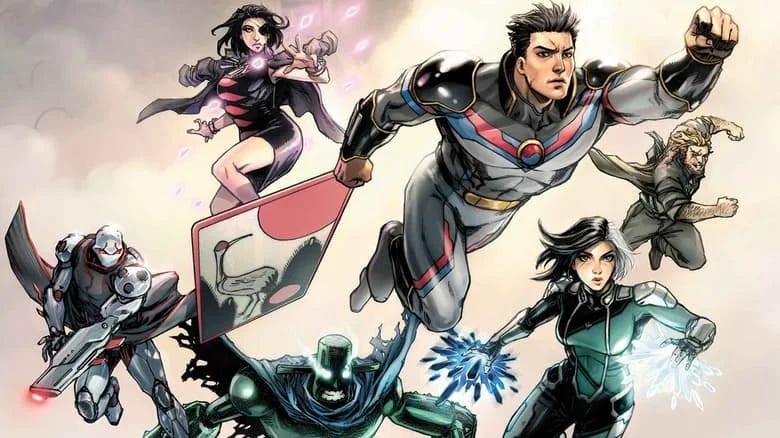
A pastor who reads comic books and has stopped apologizing for it. Who is waiting with unseemly urgency for Marvel to continue Tiger Division. (Greg Pak. Marvel editorial. Whoever currently has the keys: let’s do it. I am checking for updates like a man refreshing weather radar before he mows, except the lawn never gets mowed because I keep checking my phone.)
A man who fell into lucha libre and then started learning Spanish because of lucha libre, which began as a side effect and became a genuine love. The language. The culture. The whole thing. I study on Duolingo. On the same phone I am addicted to. Using the device that is slowly eating my attention span to learn an entire language, which is either inspiring or the most Josh sentence I have ever written. Possibly both.
A man who is cautiously, nervously getting into joshi and who has to actively talk himself out of the low hum of imagined judgment that comes with being a forty-something pastor in Ohio watching this. There is a specific anxiety to it. A voice that asks: is this okay? Will someone think this is weird? Does this fit? And then I remember that Bull Nakano was one of the best performers in the history of this art form. That Manami Toyota changed what people understood wrestling could be. That the wrestling is excellent and the voice asking whether it’s okay is just the costume talking.
I’m learning to let myself enjoy things before I’ve gotten permission.
I know what you’re thinking.
What does any of this have to do with Brad Armstrong?
Underneath every gimmick, Brad Armstrong was still Brad Armstrong.
That’s the whole thing. That’s what Austin was pointing at. That’s what Ross meant. You could call him any name, put him in any mask, hand him a bag of candy or a spider suit that attracted the attention of Marvel’s legal department and the real guy was always in there. Doing the work. Giving you something genuine. Impossible to fully bury.
The Armstrong Curse wasn’t a curse. It was a man who knew who he was, even when nobody else seemed sure what to call him that month. He just kept working. Kept showing up. Kept being exactly himself underneath whatever they dressed him in.
I have had a lot of gimmicks.
But underneath all of it, it has always been the same guy. The same anxious, trying, nerdy, approval-hungry, genuinely devoted, comic-book-reading, lucha-loving, Joshi-curious, two-blanket-having, Duolingo-on-the-addiction-phone, desperately-waiting-on-Tiger-Division guy.
Still Josh.
The flaws are part of it. The anxiety is part of it. The phone and the food and the deep need to be liked and the forty years of costume changes: all of it is part of me. I’m not fixing these things so much as I’m learning to live at home with them. To know their names. To let them ride along without letting them drive.
The costume is still around. Probably always will be. But I’m wearing it looser these days. The real guy gets to be in the room more than he used to.
That’s the work. That’s enough.
Underneath the mask — it was always Brad.
Underneath all of this — it’s always been Josh.
I think he’s finally getting over.